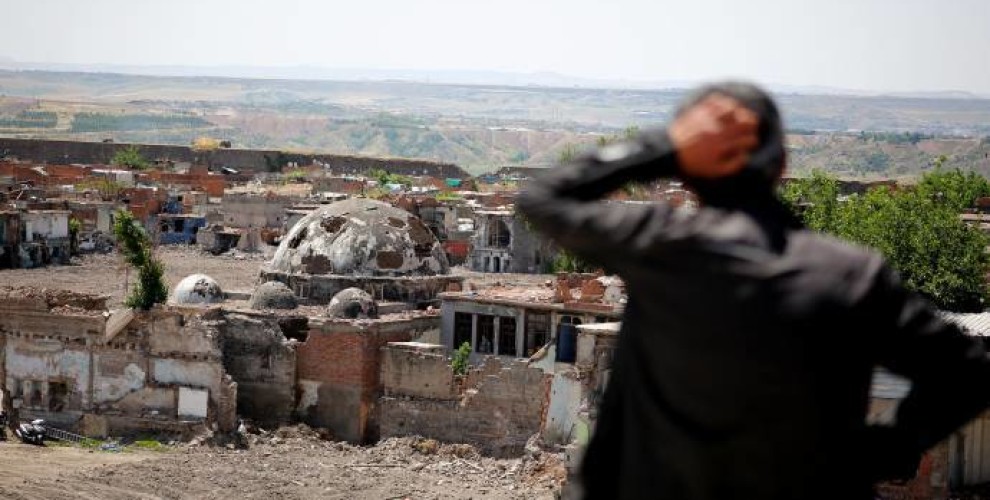


A new report has been released by the World Heritage Watch on the destruction of large parts of the 7000 years old city (Suriçi) of Amed (Diyarbakir) in North Kurdistan by the Turkish state since the beginning of 2016.
The World Heritage Watch Report 2017 gives wide coverage to the destruction of the Old City (Suriçi) of Diyarbakır since 2015 and its current status.
The report by Ercan Ayboga from Sur Conservation Platform has been written two months ago and does not include the ongoing displacement attempts of thousand people of Suriçi in the non destroyed parts. They are in these days resisting state oppression. The report by World Heritage Watch (WHW), a NGO which does advocacy work for a stronger civil society role in the protection of World Heritage Sites, is as follows;
“Located on the transition line between Anatolia, Mesopotamia and the Ararat plateau, Diyarbakır lies at a junction where main caravan routes have intersected from ancient times to the present. The first fortress is assumed to have been built by the Hurritaens in the 3rd century BC. Housing numerous civilizations and states during its history, the city also functioned as a regional capital (center) for the Persian, Roman, Sassanian, Byzantine and Islamic era empires thanks to its geopolitical importance. With its multi-lingual, multi-cultural and multi-layered character the city hosts various cultural properties in urban archaeological sites, which include distinctive civil architecture, public structures, and religious architecture comprising the structures of mosques and churches.
The fortified old city (Suriçi) has a total of 595 registered structures, of which 147 are monumental and 448 others are examples of civil architecture. In 1988, Suriçi, involving the citadel (Inner Castle), was officially put under conservation as the “Diyarbakır Urban Archaeological Site”. The first protection-oriented development plan made in the Suriçi area in 1990 was revised as the “Surici Urban Conservation Plan” in 2012. After the nomination of the “Diyarbakır Fortress and Hevsel Gardens Cultural Landscape” for the UNESCO World Heritage List in 2012, a Site Management Plan was worked out based on a participative approach with municipalities, related governmental institutions, NGOs, initiatives, scientists and neighborhood mayors in the city. During the 39th session of the UNESCO World Heritage Committee in Bonn/Germany in June/July 2015, the property was inscribed on the World Heritage List.
Conflict period in the walled old city (Suriçi)
The end of the 2.5-year-long ceasefire and negotiations for a solution to the Kurdish question between the Turkish government and the Kurdistan Workers Party (PKK) in July 2015 had grave impacts on the World Heritage Site, particularly Suriçi. The armed conflict quickly reached the city of Diyarbakir. For all or certain parts of Suriçi, the buffer zone of the World Heritage site, curfews were declared six times for several days each from September 2015. These curfews were 24-hour-a-day blockades and led to clashes between Turkish state forces and Kurdish rebel groups, resulting in the deaths of hundreds of people and serious destruction of the affected area.
The last ongoing curfew from 11 December 2015, accompanied by the use of heavy military weapons such as tanks, mortar and artillery by the government, was the most devastating one. Numerous historical buildings and monuments – as well as the integrity and authenticity of Suriçi – suffered damage and destruction. The state operations finished officially on 10 March 2016, but a blockade of the five neighborhoods Dabanoğlu, Fatih Paşa, Hasırlı, Cemal Yılmaz and Savaş continues. Experts from the observation and control commissions of the World Heritage Site Management body – at that time situated in the Diyarbakir Metropolitan Municipality – have carried out three examinations of the affected neighborhoods and have prepared reports on their findings.
Since 11 December 2015, due to the refusal of access to the affected area for Site Management personnel, all assessments of damage and destruction due to armed conflict have been carried out based on news reports in the local and national media, limited individual observations, talks with displaced people from the affected area, and information and images shared by the Governor of Diyarbakir. All reports have been sent to the Turkish Ministry for Culture and Tourism, the Turkish National Commission for UNESCO, the ICOMOS Turkish National Commission, and the ICORP Turkey Commission with requests to do broader assessments and take measures for improvement and conservation in cooperation with the World Heritage Site Management body in the affected areas. All requests of the Site Management have been denied, postponed or remained unanswered.
The dimension of the ongoing destruction
The intensive three-months-long armed conflict between December 2015 and March 2016 has caused serious destruction in the affected five neighborhoods of Surici. However, the period after 10 March 2016 has seen significantly more destruction. The Turkish government has attempted to justify the continued blockade of these neighborhoods after 10 March 2016 by referring to ongoing security problems. But Turkish security forces and employees have entered the affected area on a daily basis. Dredges and other heavy equipment have been used on the order of the Turkish government in the affected neighborhoods for the systematic destruction of registered and non-registered buildings, of which the majority had no or light damage, and roads have been opened or broadened. In one part of the affected area, grave damage has been observed on the authentic streets, non-registered housing buildings, civil architectural elements and texture of the registered buildings.
In a larger part, satellite images and other photographs show that numerous blocks of buildings have disappeared in a large area. The neighborhoods of Fatih Paşa, Hasırlı and Cemal Yılmaz, in particular, have lost the overwhelming majority of their structures. The Turkish government has not demonstrated any serious effort even to salvage authentic elements of historical buildings and monuments among the debris which has been excavated quickly and roughly. To summarize, the authentic historic fabric of almost half of the old city of Diyarbakir has been lost forever.
The fortress, which is the core of the World Heritage property, has suffered damaging impacts from the Turkish government and security forces. For example, poles have been put into the walls and towers, creating meter-long holes; toilets have been installed on the fortress for soldiers and police, significantly contaminating the walls with waste water; many small structures have been built at the foot of the walls; and military equipment has been installed on the towers in order to shoot into Suriçi.
Aside from the physical destruction, the continuity of community and private life has been disrupted. Production based on handicrafts and trade has been terminated. Almost 20,000 people from destroyed houses have been displaced, bringing to an end a lifestyle with a history of thousands of years.
Suriçi comprises 148 hectares, of which almost 70 hectares cover the five blocked neighborhoods. Based on a satellite image from 10 May 2016, it appears that 10 hectares have been completely destroyed. A second satellite image from 16 August 2016 shows that 20 hectares have been destroyed completely.
This means 1519 buildings have been completely destroyed and 500 more have been partially destroyed. This includes 33 civil architectural, three cultural monument structures and 53 environmentally important buildings that have been completely destroyed. Seventeen civil architectural, seven cultural monument structures and 15 environmentally important buildings have been partially destroyed. A further 25 civil architectural, three cultural monument structures and 13 environmentally important buildings have been damaged. In total, this means 170 architecturally registered and protected buildings and structures have been destroyed or damaged. From an aerial photo dated 4 March 2017, it can be stated that destruction has continued at the same speed since the second satellite image was taken in August 2016. Approximately 35-40 hectares in the eastern part of Surici have been destroyed to date.
What should have been done in order to prevent the loss of architectural elements and texture at registered constructions sites that experienced damage due to this armed conflict? First, assessment works should have been prioritized, followed by the conservation of authentic building elements on site. These should have occurred before the commencement of any excavation. Such works should be carried out while taking into consideration the fact that the city is a World Heritage property, and by adopting a participative approach at the center of all programs and projects.
Legal issues and other developments
Parallel with the ongoing destruction, the Turkish government has taken other grave measures with respect to Suriçi. An expropriation order was issued for Suriçi by the Cabinet of Ministers on 21 March 2016. This covered 82% of the total area of Suriçi, including monuments such as churches and mosques. The remaining 18% already largely belonged to governmental institutions. To date, the implementation of this expropriation order has been started for a major part of the destroyed eastern part of Suriçi. For people in rented accommodation, the government has offered only around 2000-3000 Euros for their furniture and other possessions which they had to leave behind when they were forced to leave their houses.
The government claimed that with the expropriation Suriçi would be developed and reconstructed according to the Suriçi Urban Conservation Plan (2012). All steps taken so far have contradicted this claim. Based on the plans and projects presented to the public from 2016, it is feared that the whole demography of Suriçi would change in favor of higher social classes and unsustainable forms of tourism run by big companies. Considering that Suriçi is at the core of the public memory of Diyarbakır city, the government’s approach would disrupt the cultural continuity by annihilating a collective memory based on the accumulation and hand-over of urban property that have continued for a millennium.
In September 2016 the Turkish government made a decision which put all management of cultural sites in Turkey, including World Heritage sites, under the direct control of the ministry for culture and tourism. The management body for the World Heritage site of Diyarbakir has thereby lost its independence. Two months later, the Diyarbakir Metropolitan Municipality was put under forced administration by the Turkish government after the co-mayors were arrested. This undemocratic control allowed the revision of the Suriçi Urban Conservation Plan in December 2016, thereby legalizing all destruction and other measures taken in Suriçi since the end of 2015.
The Hevsel Gardens and other parts of the Tigris Valley, which are part of the World Heritage property, have not been significantly affected by the armed conflict but are now in danger. The government has declared almost the whole heritage area and buffer zone in the Tigris Valley as an area subject to new planning. In doing so, the former Tigris Valley Project, which had been canceled after a court appeal by the Metropolitan Municipality in 2015, is taken as a basis for that.
In March 2017 the UN Committee for Human Rights published a report on human-rights violations in the mainly Kurdish south-eastern province of Turkey and accused the Turkish government of systematic human-rights violations, including the destruction of settlements and the displacement of hundreds of thousands of people. The contents of this report included the situation in Suriçi. On 24 March 2017, the UN Security Council approved a separate resolution – 2347 (2017) – on the destruction of cultural heritage by nonstate and state actors.
In this regard the demands are:
- • The Turkish government must immediately cancel the curfew in Suriçi, stop all activities of destruction and expropriation, rescind the revision of the Urban Conservation Plan, cover the costs of reconstruction of housing for displaced people, and implement a new site-management plan in which the active and equal inclusion of civil society must be assured;
• The UNESCO World Heritage Committee and its Advisory Bodies must immediately send a reactive mission to Diyarbakir, without requiring the permission of the Turkish government, or obtain independent and reliable information about the condition of the property otherwise. Its assessment and documentation must be carried out based on high standards of conservation through a commission with the participation of independent scientists from different fields, broad civil society, the Turkish Ministry for Culture and Tourism, and related municipalities;
• The UN Security Council must take action if the Turkish government rejects the above demands and thus call in the International Criminal Court.”